Chinese e-commerce seeks warehouse space in CEE
01 july 2026

Contents
Imports from China and the scale of e-commerce in Poland: €57.9 bn and 100 million parcels a year
In 2025, Polish imports from China reached EUR 57.9 billion, while Polish exports to China amounted to EUR 3.1 billion. Notably, imports from China already account for 15.5% of Poland’s total imports, having grown at around 13% annually compared with roughly 6% growth in overall import volumes. The growth trend in e-commerce is equally pronounced: Temu, Shein, and AliExpress generated approximately PLN 11.6 billion in turnover in Poland between autumn 2024 and autumn 2025, corresponding to around 100 million shipments per year. This illustrates that trade relations are currently far stronger than investment ties, with Poland serving primarily as a consumer and distribution market for Chinese companies.
A concrete demand driver for warehousing: fulfillment, cross-dock hubs and returns handling inside the EU
For the warehouse real estate sector, this represents a tangible demand driver. The natural response from Chinese giants may be to locate a larger share of inventory within the European Union. In practical terms, this translates into increased demand for fulfilment centres, buffer warehouses, cross-docking hubs and facilities supporting returns processing and fast multi-market distribution.
Europe Unlocked: signals from Shanghai and Guangzhou on Chinese occupiers entering CEE
This trend is also visible in discussions with prospective Chinese tenants. As part of Europe Unlocked – a Cushman & Wakefield initiative delivered with support from our APAC team – we met in Shanghai and Guangzhou with companies planning to enter or expand within the European Union. Interest in logistics space in Poland and the wider CEE region is tangible, although its precise scale remains difficult to quantify. Demand estimates should be treated with caution, as the same enquiries often circulate across the market via multiple channels. Even under conservative assumptions, potential volumes are significant for the Polish market, where gross take-up totalled 1.58 million sqm in Q1 2026.
Why Poland? The largest warehouse market in CEE, seaport access and proximity to Germany
Poland is strongly positioned within this landscape. It is the largest warehouse market in CEE, with more than 37 million sqm of existing stock, robust road infrastructure, access to the ports of Gdańsk and Gdynia, proximity to Germany, and a logistics ecosystem dedicated to e-commerce. At the same time, Poland does not always compete through direct investment incentives as aggressively as some other markets in the region, including Hungary. Its competitive advantage therefore rests primarily on market size, infrastructure quality, the availability of modern warehouse space and overall operational predictability.
Chinese occupiers: an opportunity for developers, but a new risk and compliance profile
For warehouse owners and developers, this represents both an opportunity and a challenge. Chinese occupiers typically require large-scale facilities, rapid delivery timelines, technical flexibility and highly efficient decision-making processes. At the same time, their risk profile differs from that of traditional, long-term logistics operators. For landlords and investment funds, the key consideration is therefore not only the scale of potential demand, but also the strength of the tenant covenant, the occupier’s compliance profile, and the reletting risk associated with facilities configured for a single company. In other words, the volume of space should be assessed alongside the certainty of a lease agreement.
Is speculative development set to return? Net take-up up 78% YoY against tightening supply
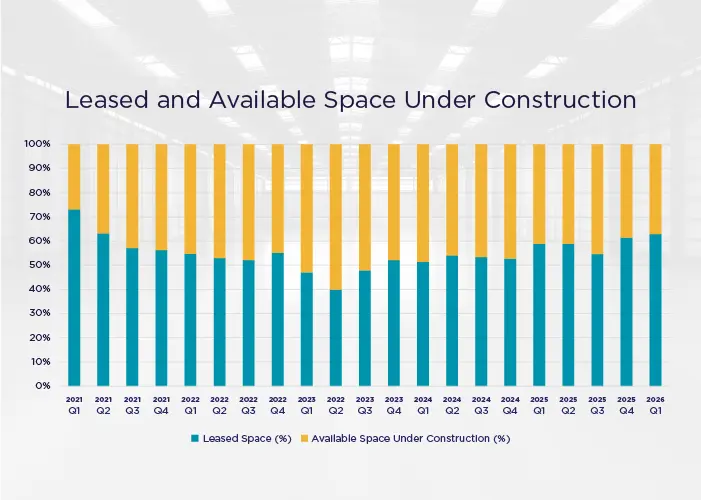
This emerging demand could place additional pressure on the availability of ready-to-occupy warehouse space and, in selected locations, revive the case for speculative development, which has been scaled back in recent quarters following the slowdown from the peak of the e-commerce boom. Figures for Q1 2026 illustrate the market backdrop well. Net take-up in Poland rose by 78% year-on-year, yet only around 37% of the space currently under construction is being developed on a speculative basis. The remaining pipeline has already been secured through pre-lets. This is particularly evident in high-demand markets such as Lower Silesia, where the vacancy rate fell from double digits to low single digits within a single quarter. As a result, the supply of large, contiguous units for immediate occupancy has become constrained. Should the growing volume of enquiries from Chinese occupiers translate into actual leasing activity, the market may struggle to meet demand in the near term, bringing speculative development firmly back into focus.

Poland as a gateway for e-commerce into the EU – speed of market response matters more than headline rent
The changes to customs duties could therefore become a catalyst for the shift from direct cross-border shipments towards inventory held within European distribution hubs. For Poland, this presents an opportunity to reinforce its position as one of the European Union’s leading gateways for global e-commerce. Success will depend on the market's ability to respond quickly, the availability of suitable space and a readiness to deliver at the pace expected by new occupiers. That said, warehouse leasing decisions should not be made solely under time pressure. In Europe, the biggest cost is not always rent, but selecting the wrong location or facility – one that ultimately proves difficult to exit over time.
Was this article helpful?